Pacific Islands · France
New Caledonia
A 38 m chimney built by freshwater springs venting inside the lagoon
Photo: Jean Rerêve · CC BY-SA 4.0
New Caledonia is ringed by the world's largest lagoon, 24,000 square kilometres inside a barrier reef second in length only to Australia's, and UNESCO-listed since 2008. Passes like Boulari flush the lagoon twice a day and pull grey reef sharks and eagle rays onto the reef corners. The lagoon holds a dugong population and an exceptional density of banded sea kraits, and the Aiguille de Prony is a strange one-off — a 38 m limestone chimney built by freshwater springs venting on the seabed.
About diving in New Caledonia
Most diving is done as half-day, two-tank runs from Nouméa, and the width of the lagoon sets the rhythm: the barrier reef is far enough out that boats leave early, dive and are back for lunch. Pass dives are scheduled against the tide rather than the clock, so a briefing time can shift by hours from one day to the next. Trips rarely cancel outright, because when the outer reef is rough the crews fall back to the islets and coral inside the lagoon and dive something calm instead.
Three quite different kinds of diving sit inside one territory. Inside the lagoon there are shallow coral flats and sand around the islets off town, easy and current-free, which is where courses and check dives happen. Out on the barrier the passes are the problem to solve: water funnels through on the tide, and the job is dropping accurately onto a corner and holding there while the resident fish work the flow. The Loyalty Islands are different geology again — uplifted coral ringed by drop-offs into open ocean.
The Aiguille de Prony is the oddity worth planning a day around. Hyperalkaline groundwater, filtered through the ultramafic rock of the far south, vents on the floor of Prony Bay and precipitates carbonate where it meets seawater, so the structure grows upward around the seeps. It is living geology rather than reef, the growth on it looks nothing like a coral site, and the bay water is darker and greener than anything on the outer reef. Elsewhere the dives people remember are the pass corners, where the tide does the work and you hold position and watch.
This suits divers who want variety inside one trip and do not mind arranging it, since an easy islet dive, a pass on a running tide and a Loyalty Islands wall are effectively three trips stitched together by short domestic flights. It is French-speaking, briefings default to French and English is worth confirming when you book, and prices track metropolitan France more than the rest of the Pacific, though good roads, hire cars and food make non-diving days easy. Divers after one fixed site for a week, or guaranteed big-animal encounters, will do better elsewhere.
When to dive New Caledonia
| Jan | Feb | Mar | Apr | May | Jun | Jul | Aug | Sep | Oct | Nov | Dec |
|---|---|---|---|---|---|---|---|---|---|---|---|
| Fair | Fair | Good | Good | Good | Good | Good | Good | Prime | Prime | Prime | Good |
Sep–Dec is warmest and clearest before the wet season; Jan–Mar is cyclone season, and winter water drops to about 21°C.
Getting there
International flights land at La Tontouta, well outside Nouméa, with most arrivals from Australia, New Zealand and Japan. Divers usually base in Nouméa and dive from day boats there; Lifou, Maré and the Île des Pins are short hops from Magenta airport in town and run their own small operations.
Wildlife calendar
Sea kraits are the constant: they haul out to rest and digest on the islets, so you meet them on the sand as often as in the water. Grey reef sharks work the running tide in the passes alongside barracuda, trevally and napoleon wrasse, turtles are routine over the lagoon reefs, and nudibranchs are reliable on the Loyalty walls. Dugongs are present but rarely seen.
Dive types & marine life
- Reef
- Wall
- Drift
- Cave & cavern
- Coral garden
- Wreck
- Reef sharks
- Sea turtles
- Sea snakes
- Napoleon wrasse
- Trevally & jacks
- Dugongs & manatees
- Manta rays
- Nudibranchs
- Pristine corals
- Barracuda
Notable dive sites in New Caledonia
Passe de Boulari
Tidal pass off Nouméa with grey reef sharks holding in the current.
Aiguille de Prony
Limestone chimney rising from 38 m, built by freshwater seabed springs.
Îlot Amédée
Lighthouse islet with easy coral gardens and abundant sea kraits.
Gorgone Wall
Lifou wall in the Loyalty Islands, sea fans from 20 m to past 50 m.
Shoji Point
Lifou headland dropping into blue with exceptional visibility.
Récif Sénez
Outer barrier reef site with hard coral and passing pelagics.
Photos from New Caledonia
Pujolle · CC BY-SA 3.0
Ftissantier · CC BY-SA 4.0
Bahnfrend · CC BY-SA 3.0
Eustaquio Santimano · CC BY 2.0
Dive videos
Diving New Caledonia - Nouméa - Passe de Boulari (100+ Grey Sharks and baby sharks) · Anne-Charlotte JOLY - KRAC PROD on YouTube
Diving New Caledonia - ⭐ Pelagic encounters ⭐ | Whales, manta rays, grey sharks · Anne-Charlotte JOLY - KRAC PROD on YouTube
Photo credits
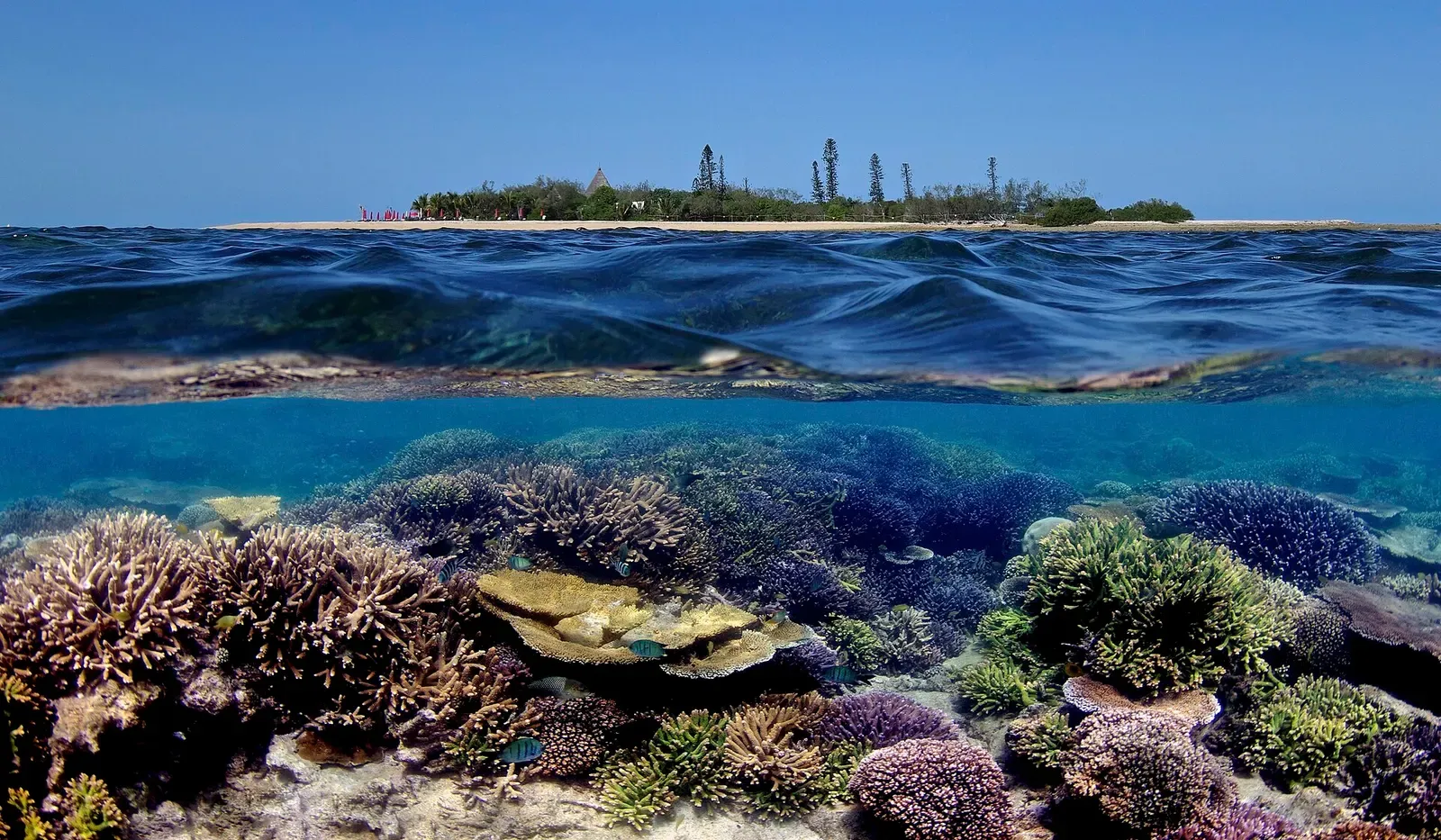
- Split over-under view of a New Caledonia coral reef with a lagoon islet above the waterline by Jean Rerêve, CC BY-SA 4.0, via Wikimedia Commons
- Close-up of a striped nautilus shell photographed on a night dive off Lifou by Pujolle, CC BY-SA 3.0, via Wikimedia Commons
- Aerial view of turquoise lagoon water and a dive boat moored at a jetty near Amédée islet by Ftissantier, CC BY-SA 4.0, via Wikimedia Commons
- Reef patterns visible through clear turquoise water at Jokin on the northern tip of Lifou Island by Bahnfrend, CC BY-SA 3.0, via Wikimedia Commons
- The white Amédée lighthouse rising above the islet's reef, seen from the water by Eustaquio Santimano, CC BY 2.0, via Wikimedia Commons
Similar destinations
Pacific Islands
A pinnacle rising 900 m from the seabed to within metres of the surface
Pacific Islands
A hundred kilometres of barrier reef with almost no divers on it
Pacific Islands
Majuro & Mili
Marshall Islands
Ride a channel that flushes a forty-kilometre lagoon on the tide


.JPG)

Hooked into the reef at Blue Corner while grey reef sharks patrol the current