Africa · Mozambique
Bazaruto Archipelago
East Africa's last viable dugong population, in a 1971 national park
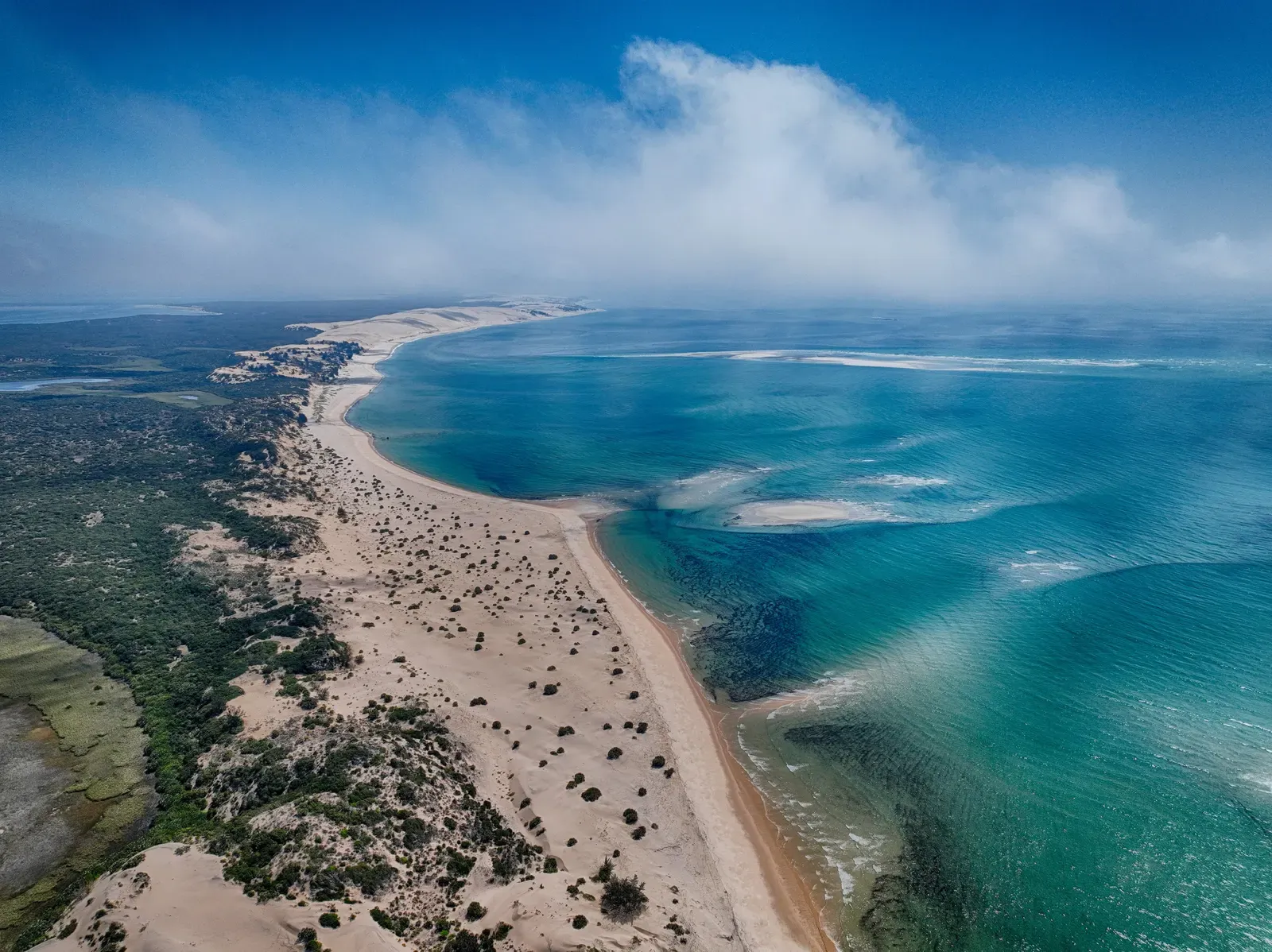
Photo: Tom Corser · CC BY-SA 3.0
The Bazaruto Archipelago is a chain of five sand islands and their surrounding reefs, protected as a national park since 1971 and holding the last viable population of dugongs in East Africa. Diving concentrates on Two Mile and Five Mile Reefs, long coral ridges that catch the Mozambique Current and pull in reef mantas, whale sharks and large schools of kingfish. Conditions vary sharply with the tide, and visibility can swing from 8 m to 30 m in a day.
About diving in Bazaruto Archipelago
Diving here is a logistics exercise. The reefs lie out between the islands, so a day starts with a long boat ride, much longer from the mainland than from an island lodge, and it is planned around the tide, because the exchange between the bay and the open sea is what makes or ruins a dive. Two dives fills a morning. Crews watch the swell as closely as the clock, and having the reef you were promised swapped for a more sheltered one is a normal part of the week.
There is no fringing reef to swim out to. The islands themselves are sand, high dunes and freshwater lakes with almost no exposed rock, and the coral grows instead on submerged ridges offshore, cut by sand gullies that run roughly with the flow. Sites differ mostly by exposure: the inner ground is broader and calmer and takes most of the traffic, while the outer ridges sit further into the current and are where the bigger animals cross. Inside the bay it is seagrass and sand.
The draw is the chance of something large in open water, over coral that is in reasonable condition but is not really why people come. Mantas holding on a cleaning station and kingfish working the ends of a ridge both come down to being in the right spot while the water is moving, which is why crews chase the tide rather than the site list. Conditions shift fast enough that two divers describing the same reef a week apart can sound as though they were nowhere near each other; the settled middle of the year is the safer bet.
It suits divers who take a trip as a series of chances rather than a guarantee, and who are content with a couple of dives a day from a remote base with little else running. The park's rules are enforced, lodges are effectively the only infrastructure, and costs sit at the top end of the Mozambican coast as a result. What decides whether someone enjoys it is less the card in their pocket than their tolerance for moving water and hours on a boat, so anyone prone to seasickness should think hard about the crossings.
When to dive Bazaruto Archipelago
| Jan | Feb | Mar | Apr | May | Jun | Jul | Aug | Sep | Oct | Nov | Dec |
|---|---|---|---|---|---|---|---|---|---|---|---|
| Good | Good | Good | Good | Prime | Prime | Prime | Prime | Prime | Prime | Good | Good |
May–Oct is calmest with the best visibility; humpbacks pass Jul–Oct and whale sharks are most common Nov–Mar.
Getting there
Vilankulo on the mainland is the gateway, with flights from Maputo and regional connections from Johannesburg, then boats or light aircraft on to the island lodges. Day boats run from Vilankulo, but the ride out is long; staying on Bazaruto or Benguerra shortens it considerably. All diving is boat-based, and the national park charges an entry fee.
Wildlife calendar
Reef mantas and schooling kingfish are what most people book for, though both come down to tide and luck, while turtles, eagle rays and grouper are the steadier company on the ridges year-round. Humpbacks are through from July into October and are sometimes audible underwater; whale sharks are most likely Nov-Mar. Dugongs persist in the bay's seagrass but are almost never seen on a dive.
Dive types & marine life
- Reef
- Wall
- Drift
- Coral garden
- Pelagic & blue water
- Dugongs & manatees
- Manta rays
- Whale sharks
- Reef sharks
- Sea turtles
- Groupers
- Trevally & jacks
- Eagle rays
- Dolphins
- Whales
Notable dive sites in Bazaruto Archipelago
Two Mile Reef
Long coral ridge at 12–28 m, the archipelago's main dive.
Five Mile Reef
Outer reef with stronger current, kingfish schools and manta passes.
Aquarium
Shallow section of Two Mile Reef in 12 m, dense with reef fish.
Cabo San Sebastião
Mainland peninsula reefs to the south with manta cleaning stations.
Photos from Bazaruto Archipelago
Bjørn Christian Tørrissen · CC BY-SA 3.0
Dive videos
Diving Two Mile Reef, Bazaruto Island, Mozambique · Reef Builders on YouTube
Scuba Diving Bazaruto Island in Mozambique · The Blonde Abroad on YouTube
Photo credits
- Aerial view of Bazaruto Island's coastline, showing white dunes, a turquoise channel, and reef patches visible beneath the clear water by Tom Corser, CC BY-SA 3.0, via Wikimedia Commons
- An old fossilized reef exposed at low tide along Bazaruto Island's shore, with a young mangrove stand taking root behind it by Bjørn Christian Tørrissen, CC BY-SA 3.0, via Wikimedia Commons
Similar destinations
Tidal gaps flush an 800 m channel past sheer coral walls
Thousands of green turtles nest on one protected stretch of coast
Juvenile whale sharks feed in shallow water off Mafia most of the year.


An atoll wall and easy coral slopes off Zanzibar's north-east corner