Australia & New Zealand · Australia
Julian Rocks — Byron Bay
Tropical and temperate species overlap on one rock 2.5 km offshore
Photo: JulianGWilson · CC BY-SA 4.0
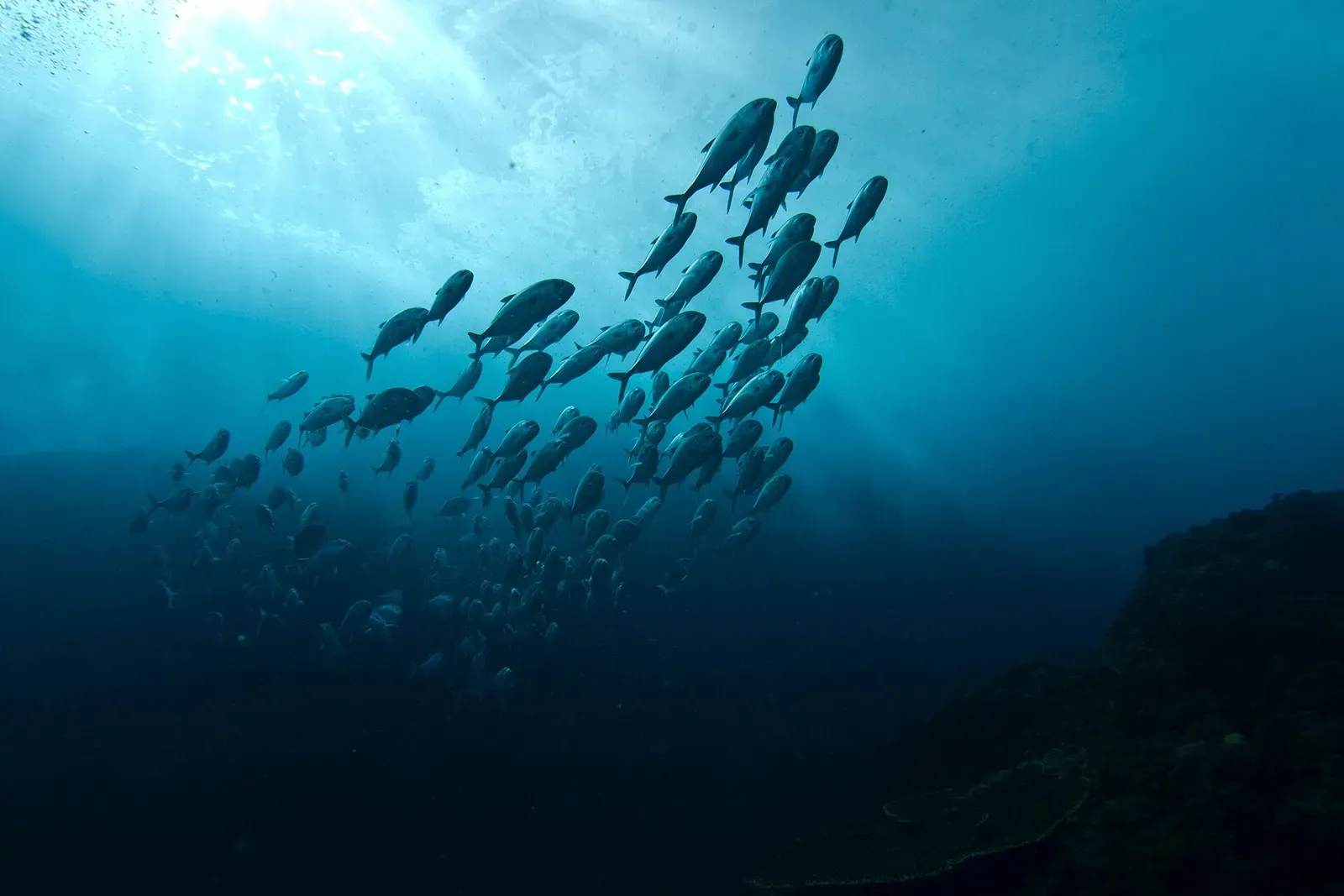
Julian Rocks lies 2.5 km off Australia's easternmost point, where the warm Eastern Australian Current meets cooler southern water and tropical and temperate species overlap on the same reef — more than a thousand species on a single rock. The seasonal turnover is the appeal: leopard sharks in summer, grey nurse sharks through winter, manta rays either side, and wobbegongs, turtles and rays the whole year. Everything sits between 8 and 25 m.
About diving in Julian Rocks — Byron Bay
Byron has no harbour, so the boats launch off the beach: gear is loaded on the sand, a tractor pushes the inflatable out through the shorebreak, and you leave already suited up. The run out is short, trips are almost always a double dive with the interval spent on board, and departures cluster in the morning before the afternoon sea breeze gets up. Snorkel and freedive trips work the same rock, so a group with non-divers in it is easy to keep together.
One island, several quite different dives. The sheltered side is shallow, with sand between boulder patches, calm enough for a first dive in the ocean. The exposed outer side is deeper, cut into gutters, spires and short swim-throughs, and it takes the current. Which side you get is decided on the morning by wind, swell and tide rather than by request, so a few days here turn up more variety than any single trip suggests.
The rock carries long-standing cultural significance for the Arakwal Bundjalung people, known to them as Nguthungulli, a name the nature reserve now carries. It also sits inside Cape Byron Marine Park as a sanctuary zone, so fishing is off-limits over it and crews brief on approach distance and behaviour before every dive. Shallow depths across the island mean dives more often end on time than on air, which is part of why locals log hundreds of them here.
It fits new divers, mixed-ability groups and people already in Byron for other reasons, since the diving slots into a holiday rather than dictating it, while more experienced divers come for the seasonal headliners and the deeper exposed ground. Worth knowing before booking: this is one island rather than a spread of sites, it gets busy through school holidays, and the beach launch is the weak point, with nothing running when the swell makes getting off the sand unworkable.
When to dive Julian Rocks — Byron Bay
| Jan | Feb | Mar | Apr | May | Jun | Jul | Aug | Sep | Oct | Nov | Dec |
|---|---|---|---|---|---|---|---|---|---|---|---|
| Prime | Prime | Prime | Good | Good | Prime | Prime | Prime | Prime | Good | Good | Prime |
Leopard sharks arrive Dec–Apr and grey nurse Jun–Nov, so the site has a marquee species almost year-round.
Getting there
Ballina Byron Gateway and Gold Coast are the usual airports, roughly half an hour and an hour from Byron Bay by road. The town is the base, with dive shops in the centre and boats going off Main Beach. There is no shore access to Julian Rocks, so every dive is a day boat, morning departures first and extra runs added when conditions allow.
Wildlife calendar
Leopard sharks gather over the sand from about December into April, and grey nurse sharks stack in the deeper gutters from mid-year through spring. Manta rays turn up between the two, more a lucky day than something to book. Wobbegongs, turtles, stingrays and eagle rays are resident, with dense bait schools and a long nudibranch list at any time of year.
Dive types & marine life
- Reef
- Drift
- Cave & cavern
- Night
- Wall
- Sand tiger sharks
- Wobbegongs
- Manta rays
- Sea turtles
- Reef fish swarms
- Stingrays
- Eagle rays
- Nudibranchs
- Reef sharks
Notable dive sites in Julian Rocks — Byron Bay
The Nursery
Sheltered shallow side in 10 m, where leopard sharks gather in summer.
Cod Hole
Short cavern at 18 m with grey nurse sharks stacked at the entrance.
Hugo's Trench
Deep gutter at 25 m on the exposed side, drifted in current.
The Needles
Rock spires north of the island with schooling fish and rays.
Cray Cave
Overhang in 14 m holding crayfish, wobbegongs and resting turtles.
Photos from Julian Rocks — Byron Bay
Greg Schechter · CC BY 2.0
Greg Schechter · CC BY 2.0
AwOiSoAk KaOsIoWa · CC BY-SA 3.0
Pavel Špindler · CC BY 3.0
Dive videos
LEOPARD Sharks Of Julian Rocks In Byron Bay · Blue Horizon Diving on YouTube
How To Find A Leopard Shark 4K (Nguthungulli Julian Rocks - Byron Bay - Australia) #Scuba #byron · Nic's Underwater Beasts (and where to find them) on YouTube
Photo credits
- A school of trevally rises through blue water at Julian Rocks off Byron Bay by JulianGWilson, CC BY-SA 4.0, via Wikimedia Commons
- Cape Byron's rocky headland juts into the Pacific near the Julian Rocks dive site by Greg Schechter, CC BY 2.0, via Wikimedia Commons
- Wide view of Byron Bay's coastline and hills under a cloud-studded sky by Greg Schechter, CC BY 2.0, via Wikimedia Commons
- Sunlit ocean and rocky point at Byron Bay, gateway to the Julian Rocks dive site by AwOiSoAk KaOsIoWa, CC BY-SA 3.0, via Wikimedia Commons
- Green headland near Cape Byron lighthouse, overlooking the waters off Julian Rocks by Pavel Špindler, CC BY 3.0, via Wikimedia Commons
Similar destinations
Australia & New Zealand
South West Rocks — Fish Rock
Australia
A 125 m ocean through-cave, and grey nurse sharks in the gutters
The highest reef manta density on the Great Barrier Reef, year-round
Tame Maori wrasse inshore, and the outer barrier sixty kilometres out
.jpg)


.jpg)

White quartz sand lifts the light over temperate sponge gardens