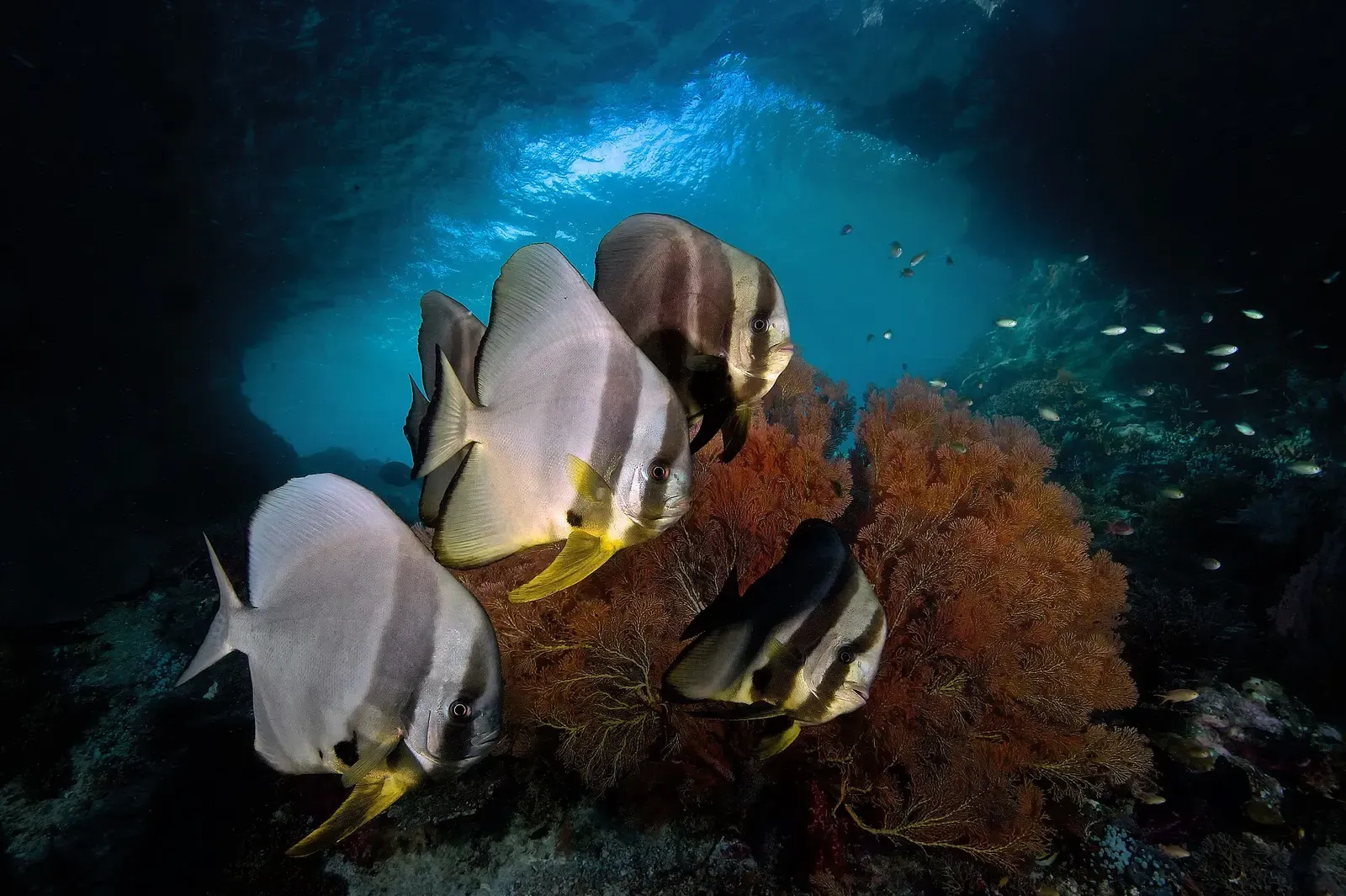
Coral Triangle · Indonesia
Raja Ampat
Manta rays hold at cleaning stations in the world's most biodiverse reef system.
Photo: Buena Ventura · CC BY 3.0
Raja Ampat sits at the heart of the Coral Triangle off West Papua, where reef surveys have recorded more hard coral and fish species per site than anywhere else surveyed on Earth. Dives range from shallow coral gardens thick with anthias and fusiliers to current-swept passages such as Cape Kri and Blue Magic, where manta rays gather over cleaning stations and big schools of jacks and barracuda hold in the current. Diving is almost entirely liveaboard- or resort-based across scattered limestone islands with little road infrastructure.
About diving in Raja Ampat
Liveaboards do most of the work here. They move overnight, moor in a bay, and run three or four dives a day from tenders rather than from the boat you sleep on, with a night dive tacked on when the anchorage suits it. The schedule follows the tide table rather than mealtimes, and briefings tend to turn on which way the water will be moving half an hour in. Resorts and village homestays on Kri, Gam and Arborek work the same reefs from fast boats, trading the far corners of the archipelago for shorter days and a fixed bed.
Diving is usually split into three areas. The Dampier Strait funnels tidal flow between Waigeo and Batanta, so its ridges, seamounts and island passages take the strongest movement and the heaviest fish traffic. Misool, well to the south, is limestone karst with soft-coral walls, big sea fans and mangrove channels where roots and coral grow together, though its seamounts can run hard as well. The far north around Wayag is remote enough that only longer liveaboard itineraries reach it.
What people remember is less a single animal than holding position and watching a reef work. Reef hooks are standard kit on the exposed ridges: tuck in below the flow and let the schooling fish and patrolling sharks stream past. Against that, the village jetty dives are nearly static, with pilings crowded with fish and small critters in shallow water, and night dives can turn up walking sharks stalking the rubble on their fins. Wobbegongs lie flat under table corals through the day.
Nothing here is technically deep, but negative entries into moving water and quick regrouping on the reef are routine, and most operators expect you to carry and deploy your own surface marker. It is also a long way from help, so trips get booked months ahead and any problem means a boat ride before a flight. The calm, clear stretch runs from roughly October into April, with November through March rating highest; mid-year stays diveable but brings southeast wind, rougher crossings and thinner boat schedules.
When to dive Raja Ampat
| Jan | Feb | Mar | Apr | May | Jun | Jul | Aug | Sep | Oct | Nov | Dec |
|---|---|---|---|---|---|---|---|---|---|---|---|
| Prime | Prime | Prime | Good | Fair | Fair | Fair | Fair | Good | Good | Prime | Prime |
October–April brings calmer seas and the clearest water; June–August SE winds roughen southern Misool crossings.
Getting there
Almost everyone routes through Sorong, on the western tip of New Guinea, on a domestic flight via Jakarta, Makassar or Manado. Liveaboards board there; resort and homestay guests continue by public ferry or charter to Waisai on Waigeo. A marine park entry permit is required and is usually arranged by the operator. All diving is boat-based.
Wildlife calendar
Mantas hold at the cleaning stations through the calmer October-to-April months and are seen outside that window too. Reef sharks, napoleon wrasse, turtles and packed schools of jacks and barracuda work the ridges whenever the tide runs, with eagle rays over the sand. Wobbegongs, pygmy seahorses and nudibranchs are the constant macro.
Dive types & marine life
- Reef
- Wall
- Drift
- Muck & macro
- Coral garden
- Manta rays
- Reef sharks
- Sea turtles
- Napoleon wrasse
- Eagle rays
- Wobbegongs
- Pygmy seahorses
- Nudibranchs
- Barracuda
- Trevally & jacks
- Pristine corals
Notable dive sites in Raja Ampat
Cape Kri
Record-holding reef fish count site with wall-to-wall schooling fish.
Blue Magic
Seamount cleaning station where manta rays circle in the current.
Manta Sandy
The most reliable manta cleaning station in the strait, best October to April, dived from a fixed viewing line
Melissa's Garden
Dense coral garden across a sloping reef top thick with anthias.
Sardine Reef
Current-swept pinnacle packed with schooling fusiliers and jacks.
Photos from Raja Ampat
lakshmioct01 · CC BY 2.0
lakshmioct01 · CC BY 2.0
lakshmioct01 · CC BY 2.0
lakshmioct01 · CC BY 2.0
Dive videos
This is Raja Ampat (4k) - dive into the dream of biodiversity · Jurrien Wiss on YouTube
RAJA AMPAT ︱THE HEART OF THE CORAL TRIANGLE︱WEST PAPUA - INDONESIA︱WORLD BEST SCUBA DIVING︱4K HDR · MOKEN PLANET on YouTube
Photo credits
- A school of striped batfish hovers beside a sea fan inside a sunlit reef cavern in Raja Ampat. by Buena Ventura, CC BY 3.0, via Wikimedia Commons
- Soft coral in deep pink stands beneath a swirling school of small silver baitfish. by lakshmioct01, CC BY 2.0, via Openverse
- A bright red sea fan spreads across a coral wall crowded with small reef fish. by lakshmioct01, CC BY 2.0, via Openverse
- A dense reef slope crowded with orange and red soft corals, sponges, and giant clams. by lakshmioct01, CC BY 2.0, via Openverse
- Jagged limestone karst islands rise from turquoise water along a Raja Ampat channel. by lakshmioct01, CC BY 2.0, via Openverse
Similar destinations
Step off a jetty into the world's largest lagoon, or cross to open ocean
The world's second-largest contiguous coral reef, closed to fishing
Cold upwellings feed current-swept pinnacles thick with sharks and schooling trevally.

A permanent tornado of jacks and barracuda on a wall from 6 m