East Asia · Japan
Yonaguni
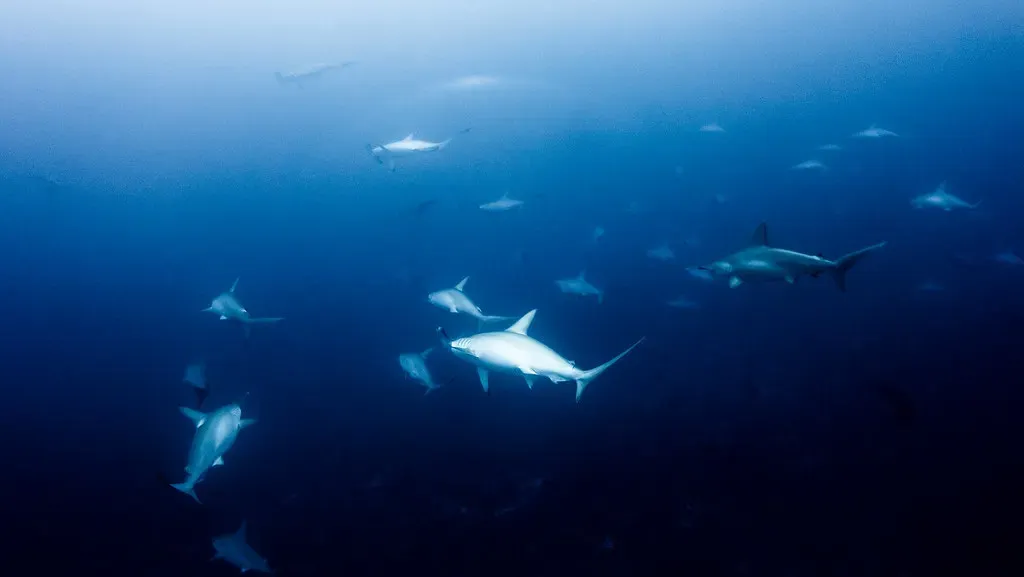
Winter hammerhead schools stack over pinnacles beside the disputed sunken Monument.
Photo: Vincent Lou (itsdesire) · CC BY 2.0
Japan's westernmost inhabited island lies barely 110 km from Taiwan, exposed to open Pacific swell and the Kuroshio current sweeping past its rocky coastline. Divers come for two draws: scalloped hammerhead sharks that stack up over deep pinnacles off the west coast each winter, and the Yonaguni Monument, a submerged terraced rock formation whose natural-versus-man-made origin geologists still debate. Strong currents and open-ocean conditions make this a serious drift-diving destination rather than a casual reef trip.
About diving in Yonaguni
Diving here runs off small boats out of the island's fishing ports, and the day is shaped by what the sea allows rather than by a timetable. Crews read the swell each morning and pick a coast; when the wind turns, trips are called off outright rather than moved. Most operators are one- or two-boat outfits taking small groups, and briefings are in Japanese unless you have arranged an English-speaking guide in advance, so it pays to book the shop before you book the flight.
The underwater terrain is rock rather than reef. Ledges step down in slabs and terraces, cut by arches, chimneys and swim-throughs that hold hard shafts of light, with soft coral and sea fans holding on wherever the flow is strongest. Sites differ mainly by exposure: the southern formations can be dived in relative calm when the north side is blown out, while the pinnacles on the open west side sit in fast-moving water and call for a quick negative entry and close buddy contact.
The shark dive is a waiting game. You drop onto a rocky shoulder, tuck in behind structure out of the worst of the flow, and watch the blue while the current streams past; the animals may pass in ones and twos, arrive in numbers, or not show at all. The Monument is the opposite exercise, a slow circuit of terraces and channels where the guide points out the features each side of the origin argument leans on and leaves you to weigh them, and where surge across the shallow steps is often harder work than the depth.
This suits divers who already own their buoyancy and are comfortable being put into moving water a long way from help; the island is small and remote enough that anything serious means an evacuation flight rather than a short drive. The winter months that bring the sharks are also when flights and the Ishigaki ferry are most likely to be cancelled, so build slack into the itinerary and expect to lose a day. Anyone after coral gardens, easy snorkelling or a resort routine will be happier elsewhere.
When to dive Yonaguni
| Jan | Feb | Mar | Apr | May | Jun | Jul | Aug | Sep | Oct | Nov | Dec |
|---|---|---|---|---|---|---|---|---|---|---|---|
| Prime | Prime | Prime | Good | Good | Good | Fair | Fair | Fair | Good | Good | Prime |
Hammerhead season peaks December to March; summer brings typhoon risk and rougher currents.
Getting there
Flights arrive from Naha and from Ishigaki on small turboprops, and a ferry crosses from Ishigaki a couple of times a week over an exposed stretch that is often cancelled. Sonai is the main village and holds most of the lodging; shops run day boats from the harbours, keeping a few shore entries as a fallback when the boats stay in.
Wildlife calendar
Scalloped hammerheads are the winter draw, schooling through the December-to-March peak and thinning as spring comes in. Napoleon wrasse, big trevally, barracuda and reef sharks work the rock through the year, with eagle rays crossing the deeper sand patches and turtles over the shallower formations.
Dive types & marine life
- Wall
- Drift
- Pelagic & blue water
- Cave & cavern
- Hammerheads
- Reef sharks
- Barracuda
- Eagle rays
- Trevally & jacks
- Napoleon wrasse
- Sea turtles
Notable dive sites in Yonaguni
Yonaguni Monument
Terraced rock formation debated as natural or man-made, plateaus from 5-27m.
Hammerhead Point
West-coast pinnacle where scalloped hammerheads school in winter currents.
Tategami Rock
Tall standing pinnacle draped in soft coral with resident schooling fish.
Palm Rock
Shallower site with swim-throughs and arches, a calmer current alternative.
Photos from Yonaguni
Vincent Lou (itsdesire) · CC BY 2.0
Vincent Lou (itsdesire) · CC BY 2.0
Vincent Lou (itsdesire) · CC BY 2.0
Vincent Lou (itsdesire) · CC BY 2.0
Dive videos
Monty Halls' Dive Mysteries: Japan's Lost Atlantis | History Documentary | Reel Truth History · Banijay History on YouTube
The Yonaguni Monument & Hammerhead Sharks Diving 4K · moet.mp4 on YouTube
Photo credits
- A school of scalloped hammerhead sharks cruises over a rocky pinnacle off Yonaguni. by Vincent Lou (itsdesire), CC BY 2.0, via Openverse
- Two scalloped hammerhead sharks swim close together over Yonaguni's rocky seabed. by Vincent Lou (itsdesire), CC BY 2.0, via Openverse
- Divers hover among sunlit rock formations and rising bubble trails at a Yonaguni dive site. by Vincent Lou (itsdesire), CC BY 2.0, via Openverse
- Two divers descend through a narrow rock canyon in Yonaguni's volcanic terrain. by Vincent Lou (itsdesire), CC BY 2.0, via Openverse
- A diver hovers over stepped rock terraces near the Yonaguni Monument dive site. by Vincent Lou (itsdesire), CC BY 2.0, via Openverse
Similar destinations
Wild dolphin encounters in Bonin Blue water 1,000 km from the nearest city.
Kuroshio-swept volcanic drop-offs with 30 m visibility and big fish
Mainland Japan's only reliable schooling hammerhead dive
Limestone arches and chambers with light shafts through the roof