Eastern Pacific · Costa Rica
Cocos Island
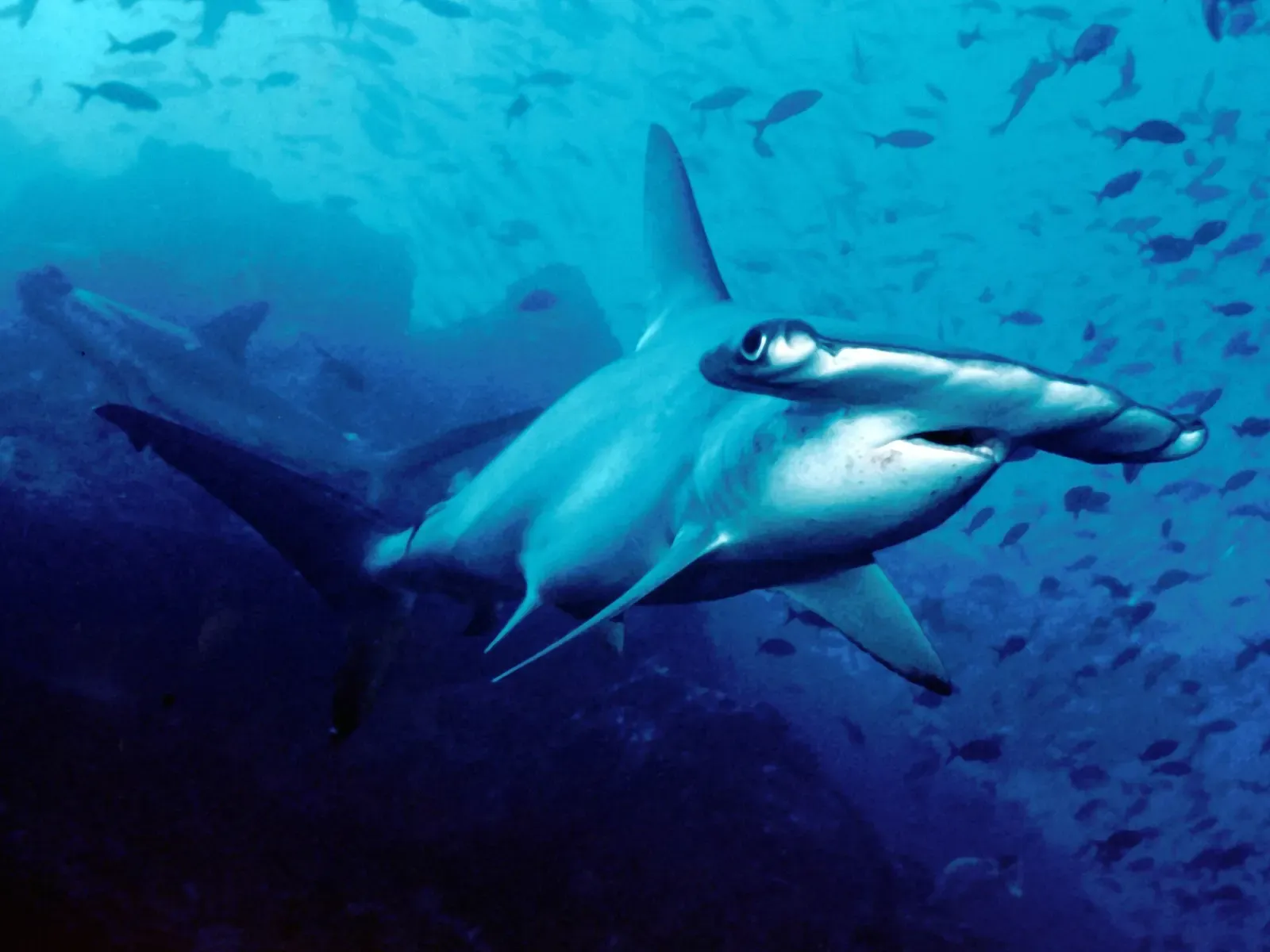
Scalloped hammerhead schools circle Bajo Alcyone's cleaning station in the current
Photo: Barry Peters · CC BY 2.0
Cocos Island lies 550 km off Costa Rica's Pacific coast, reached only by a 32-36 hour liveaboard crossing to this uninhabited, UNESCO-listed national park. Volcanic seamounts and pinnacles such as Bajo Alcyone and Dirty Rock hold cleaning stations where scalloped hammerheads school by the hundred in the current, while the sandy channels off Manuelita stack with hundreds of resting whitetip reef sharks. Rainy-season plankton blooms sharpen shark numbers and draw whale sharks through, at the cost of a sharp thermocline and murkier water.
About diving in Cocos Island
Everything runs off the mother ship. Divers ride out to the sites in pangas, roll in negative and drop straight down before the surface current takes hold, then regroup on the rock below. Most days hold three or four dives, with the tenders circling afterwards to collect surface markers — carrying and deploying one is not optional in open-ocean swell. Between dives there is nowhere much to go, since landings are at the rangers' discretion, so for the length of the trip the boat is the whole world.
The sites split into two kinds. Close to the island, the rock and sand off the bays is gentler, and the diving turns slow and observational: marbled rays parked on the bottom, morays wedged into rubble, and, out on the sand at the deeper end of those dives, the endemic rosy-lipped batfish shuffling about on modified fins. Offshore, the seamounts rise out of deep water with nothing around them, and the dive becomes a matter of getting down fast, finding shelter behind a boulder on the plateau and staying put while the blue does the work.
The signature dive is a wait. You settle into the current, keep still and watch the ridge above, and the hammerheads either drop in to be worked over by barberfish and king angelfish or they do not. Nothing about it is guaranteed, which is why itineraries return to the same seamounts day after day until they produce. The other set piece happens after dark, when the whitetips switch from resting to hunting and move over the reef in a pack that follows the torch beams, sometimes straight through the group.
It suits divers who measure a trip in animals rather than water clarity. Visibility swings hard, a thermocline can arrive mid-dive and take both the temperature and the view down with it, and coral cover is thin — the interest is what swims past the rock rather than the rock itself. The schedule is fixed and bad weather is absorbed rather than dodged, since there is no other coastline to run to. Operators generally want an advanced ticket and a logbook with real current dives in it, and the nitrox most boats carry is worth having on the deeper seamounts.
When to dive Cocos Island
| Jan | Feb | Mar | Apr | May | Jun | Jul | Aug | Sep | Oct | Nov | Dec |
|---|---|---|---|---|---|---|---|---|---|---|---|
| Good | Good | Good | Good | Good | Prime | Prime | Prime | Prime | Prime | Prime | Good |
Rainy season (Jun-Nov) brings nutrient-rich water, the densest hammerhead schools and peak whale shark sightings; dry season (Dec-May) is calmer and clearer but sharks are less numerous.
Getting there
Fly into San José and transfer overland to Puntarenas, a couple of hours away, where the Cocos boats berth and normally sail the same evening. The island has no airstrip and no visitor accommodation beyond the ranger stations, so the trip is the vessel and its schedule — commonly eight to ten days once both ocean crossings are counted.
Wildlife calendar
Whitetips, marbled rays and eagle rays are constants, and hunting tuna and jack schools work the pinnacles whatever the month. Hammerhead numbers build through the June-to-November prime stretch, which is also when whale sharks are most likely; tiger sharks are occasional rather than expected, and dolphins turn up as often on the surface interval as on a dive.
Dive types & marine life
- Pelagic & blue water
- Seamount
- Wall
- Drift
- Night
- Hammerheads
- Whale sharks
- Reef sharks
- Tiger sharks
- Tuna
- Trevally & jacks
- Eagle rays
- Stingrays
- Dolphins
Notable dive sites in Cocos Island
Bajo Alcyone
Deep seamount cleaning station famed for dense scalloped hammerhead schools
Dirty Rock
Current-swept pinnacle with hammerheads, tuna and whitetip reef sharks
Manuelita
Shallow channel where hundreds of whitetip reef sharks rest by day
Punta Maria
Exposed north-side cleaning station for schooling hammerheads
Dos Amigos Grande
Twin rock pinnacle with swim-throughs and schooling hammerheads
Photos from Cocos Island
Kris Mikael Krister · CC BY 3.0
Kris Mikael Krister · CC BY 3.0
Kris Mikael Krister · CC BY 3.0
Kris Mikael Krister · CC BY 3.0
Dive videos
Diving Cocos Island in 2025... (Shot in 8K) · Dive Hard on YouTube
Night of the Hunting Sharks! | JONATHAN BIRD'S BLUE WORLD · BlueWorldTV on YouTube
Photo credits
- A scalloped hammerhead shark swims through a school of fish over the reef at Cocos Island. by Barry Peters, CC BY 2.0, via Wikimedia Commons
- A tiger shark glides over the reef in open blue water off Cocos Island. by Kris Mikael Krister, CC BY 3.0, via Wikimedia Commons
- A group of whitetip reef sharks rests together in a rocky crevice at night. by Kris Mikael Krister, CC BY 3.0, via Wikimedia Commons
- A round ribbontail ray rests on the rocky bottom near Cocos Island. by Kris Mikael Krister, CC BY 3.0, via Wikimedia Commons
- A chestnut moray eel opens its jaws from a rocky crevice with orange fish behind it. by Kris Mikael Krister, CC BY 3.0, via Wikimedia Commons
Similar destinations
Massive hammerhead schools and giant whale sharks patrol Darwin's submerged pillars
Eastern Pacific
Malpelo
Colombia
Hammerhead schools of 200-plus circle La Nevera's cold-water cleaning station
Hannibal Bank rises from 400 m and pulls in billfish and tuna

.jpeg)
.jpeg)
.jpeg)
.jpeg)
Whitetip reef sharks stack up by the dozen on volcanic pinnacles