Caribbean · Cuba
María la Gorda
Forests of black coral in a bay that is flat calm nearly every day
María la Gorda sits at the far western end of Cuba inside the Guanahacabibes peninsula reserve, on a bay so sheltered that the water is flat almost every day of the year and most sites are five minutes from the pier. Fifty-odd moorings cover coral gardens, sand chutes, caverns and a wall, and the black coral here grows in forests dense enough that one site is simply called the Valley of Black Coral. Visibility routinely passes 30 m.
About diving in María la Gorda
The rhythm is set by the bay. Boats leave the pier in front of the hotel and are back alongside between dives, so a typical day runs two tanks in the morning, one in the afternoon and a night dive when enough people want one. The water is flat almost every day, so plans rarely change for weather, and the reef starts close enough to the beach that a dive can be walked into rather than boarded for — useful for training, and for anyone who would rather not do a third boat ride.
Underwater the same shape repeats along the bay: coral garden over white sand, then a terrace of heads and gullies, then the edge where the ground tips over and falls away. Sand chutes cut down through the reef and work as routes to that edge, and the limestone is undercut with short caverns, arches and chimneys open enough that daylight still reaches through them. The lip generally sits deep, so the drop-off tends to be the second half of a dive rather than the start of it, and sites differ less by depth than by how much structure they hold.
Black coral grows on the shaded faces below the lip, on overhangs and under ledges where light is scarce; the name belongs to the skeleton rather than the living colony, which reads brown or olive under a torch. Beyond that the appeal is consistency — clear water, little current, and enough moorings to dive a full week without repeating yourself. It is also genuinely isolated: one hotel, one dive operation, and no alternative plan if you tire of the bay.
When to dive María la Gorda
| Jan | Feb | Mar | Apr | May | Jun | Jul | Aug | Sep | Oct | Nov | Dec |
|---|---|---|---|---|---|---|---|---|---|---|---|
| Prime | Prime | Prime | Prime | Good | Good | Good | Fair | Fair | Good | Prime | Prime |
Nov–Apr is the dry season with the calmest, clearest water; Aug–Oct carries hurricane risk on this exposed western tip.
Getting there
Most divers fly into Havana and cross the island by road through Pinar del Río to the tip of the Guanahacabibes peninsula, five hours or more by hire car or arranged shuttle. The hotel beside the pier is effectively the only base, so rooms and diving are usually booked together. Bring spares, and bring cash: resupply and card payments are both unreliable out here.
Wildlife calendar
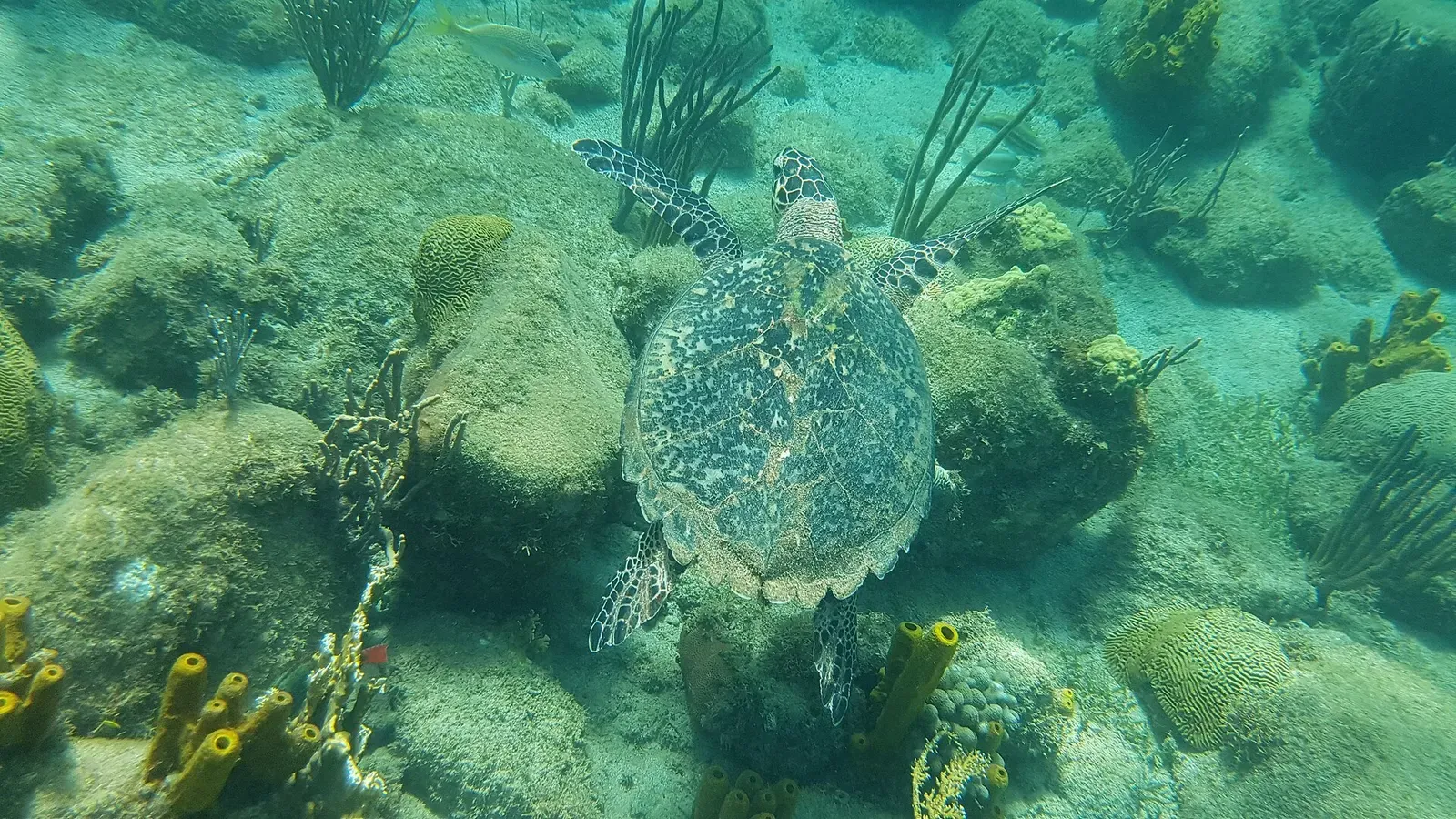
Turtles, big grouper, barracuda and eagle rays are year-round, with reef sharks along the drop-off — regular rather than guaranteed — and nudibranchs on the shallow coral. Whale sharks are reported offshore now and then but stay a matter of luck. November through April is the settled dry stretch that fits the wall and the caverns into a week; August and September are the least dependable.
Dive types & marine life
- Wall
- Reef
- Cave & cavern
- Coral garden
- Night
- Sea turtles
- Reef sharks
- Groupers
- Barracuda
- Eagle rays
- Reef fish swarms
- Nudibranchs
- Whale sharks
Notable dive sites in María la Gorda
Valle de Coral Negro
Wall section carrying dense black coral forests from 25 m down.
Salón de María
Cavern and coral chamber at 18 m, the bay's signature dive.
Yemayá
Sand chute cutting through the reef into a wall at 30 m.
Cueva Azul
Blue-lit cavern entered at 20 m with sweepers and tarpon inside.
Paraíso Perdido
Shallow coral garden in 12 m, used for check dives and night dives.
Dive videos
Amazing Diving to Maria la Gorda, June 2015 - Pinar Del Rio, CUBA · EliAlcidi on YouTube
Diving in Maria La Gorda 2015 - Cuba · Martin Rømer on YouTube
Similar destinations
A Soviet frigate lies broken in two between 15 and 30 m
The western hemisphere's third-largest barrier reef, 700 km from anywhere
A bronze Cousteau sits at 12 m in the reserve he made famous
A 350-cay national park atoll with walls and almost no other divers