Pacific Islands · United States
Maui, Molokini & Lānaʻi
Humpback song carries through every dive from December to April
Photo: Henrik Kibak · CC BY 4.0
Molokini is a crescent of volcanic crater rim standing out of the channel between Maui and Kahoʻolawe, its sheltered inner bowl holding calm, clear water and its Back Wall dropping 90 m into open ocean. Across the channel, Lānaʻi's Cathedrals are lava tubes whose collapsed roofs throw shafts of light into chambers big enough to swim through. From December to April the channel fills with humpback whales, and their song carries through every dive of the season.
About diving in Maui, Molokini & Lānaʻi
Almost everything here runs on the trade winds. Boats leave Māʻalaea Harbor early because the channel builds a chop by late morning, so a two-tank crater trip is usually finished before lunch and the site is handed over to the snorkel fleet. Molokini is a state Marine Life Conservation District, so boats pick up day-use moorings instead of anchoring and the reef is closed to fishing. The running order is decided on the ramp — the outer rim first if the ocean is flat, the sheltered inside if it is not — and afternoons go to shore entries along the south and west coasts.
The islands are young volcanic rock and the terrain follows from that. Molokini is a drowned tuff cone, and the standing arc of rim takes the trade swell off one flank, leaving a floor of sand and coral heads that shelves out gradually toward the tips of the crescent. The seaward face is the opposite: open ocean, nothing to hold on to, and a current running along the wall. Lānaʻi is different again — solidified lava left tubes, arches and roofed chambers, so those dives are about architecture and light rather than depth.
What sets the diving apart is what lives on that rock. Hawaiʻi sits a long way from any other reef system, and roughly a quarter of its shore fish species are found nowhere else, so an ordinary dive turns up fish a well-travelled diver will not recognise. The trade-off is a coral fauna that is thin by Indo-Pacific standards. Humpbacks arrive for the winter, but they are not really a dive: federal rules hold vessels and swimmers 100 yards off, so the season is heard more than seen, and the same winter swell can shut the outer rim and the Lānaʻi crossing for a day or two at a time.
It suits divers travelling with people who do not dive. Trips are half-days, the boats are comfortable, and nobody has to build a holiday around the diving: a week can be two or three boat mornings plus a handful of shore dives at your own pace. Watch the altitude if you are driving the Haleakalā summit road, which climbs above 3,000 m and needs to wait until well after the last dive. Anyone wanting dense soft coral, big schooling pelagics or a liveaboard rhythm should look further west.
When to dive Maui, Molokini & Lānaʻi
| Jan | Feb | Mar | Apr | May | Jun | Jul | Aug | Sep | Oct | Nov | Dec |
|---|---|---|---|---|---|---|---|---|---|---|---|
| Prime | Prime | Prime | Good | Good | Prime | Prime | Prime | Good | Good | Good | Prime |
Humpbacks are in the channel Dec–Apr; summer brings the calmest crossings and best visibility at Molokini's Back Wall.
Getting there
Kahului is the airport, and most divers base in Kīhei or Wailea for the south-shore boats and beach entries. Molokini and Lānaʻi trips are day-boats out of Māʻalaea Harbor and leave early, before the trades fill in. There are no liveaboards, and a rental car is worth having for the shore sites.
Wildlife calendar
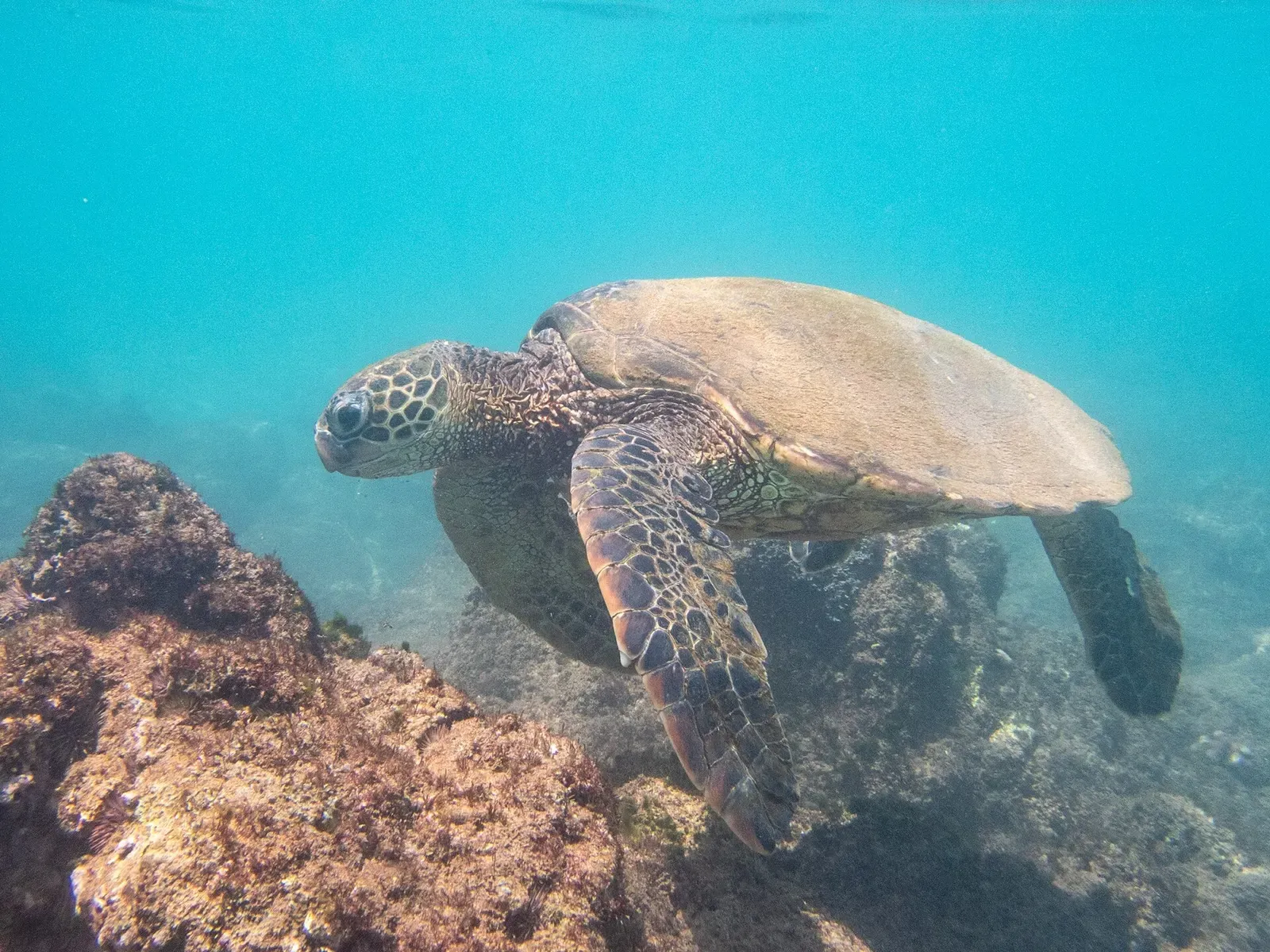
Green turtles are on the lava shelves year-round, whitetip reef sharks rest under ledges, and day octopus hunt across the shallows. Humpbacks fill the channel December to April, and spinner dolphins rest in the sheltered bays by day. Eagle rays and the occasional manta pass the outer rim, seen most in the calm summer months when the deeper drift is reliably diveable.
Dive types & marine life
- Reef
- Wall
- Cave & cavern
- Drift
- Night
- Coral garden
- Whales
- Sea turtles
- Reef sharks
- Manta rays
- Reef fish swarms
- Octopus & cuttlefish
- Eagle rays
- Dolphins
- Macro critters
Notable dive sites in Maui, Molokini & Lānaʻi
Molokini Back Wall
Outer crater rim dropping 90 m, drifted in clear open-ocean water.
Molokini Crater
Sheltered inner bowl in 10–20 m, the calmest reef dive on Maui.
Cathedrals I
Lānaʻi lava tube with light shafts through the collapsed roof at 18 m.
Cathedrals II
Larger companion cavern with multiple entrances and swim-throughs.
Turtle Town
Lava shelf off Maluaka Beach with resident green turtles at 12 m.
Mala Wharf
Collapsed pier in 10 m, dense with turtles, rays and whitetip sharks.
Photos from Maui, Molokini & Lānaʻi
Henrik Kibak · CC BY 4.0
Henrik Kibak · CC BY 4.0
Henrik Kibak · CC BY 4.0
Henrik Kibak · CC BY 4.0
Dive videos
SCUBA DIVING MOLOKINI CRATER MAUI HAWAII - 3 JANUARY 2026 - w/MAUI DIAMOND SEASPORTS - INSTA360 x5 · Go Outside Craig on YouTube
Lanai Cathedrals with Maui Diamond: Scuba Dive in LAVA TUBES! · Amy Renee Adventures on YouTube
Photo credits
- Green sea turtle swimming over a shallow rocky reef off Maui, Hawaii. by Henrik Kibak, CC BY 4.0, via Wikimedia Commons
- A green sea turtle glides past a sunlit rocky reef off Maui, Hawaii. by Henrik Kibak, CC BY 4.0, via Wikimedia Commons
- Green sea turtle cruising close above a coral-encrusted reef near Maui. by Henrik Kibak, CC BY 4.0, via Wikimedia Commons
- A green sea turtle rests near the reef edge in clear water off Maui. by Henrik Kibak, CC BY 4.0, via Wikimedia Commons
- Close view of a green sea turtle's patterned shell over the reef near Maui. by Henrik Kibak, CC BY 4.0, via Wikimedia Commons
Similar destinations
Forty-metre visibility over lava caves and canyons, straight off the reef
Pacific Islands
Savai'i & Upolu
Samoa
Lava tubes and drop-offs, with a marine reserve walkable from Apia
Touch a First and a Second World War wreck at the same time


Manta rays glide through diver spotlights on Kona's nightly manta dive.