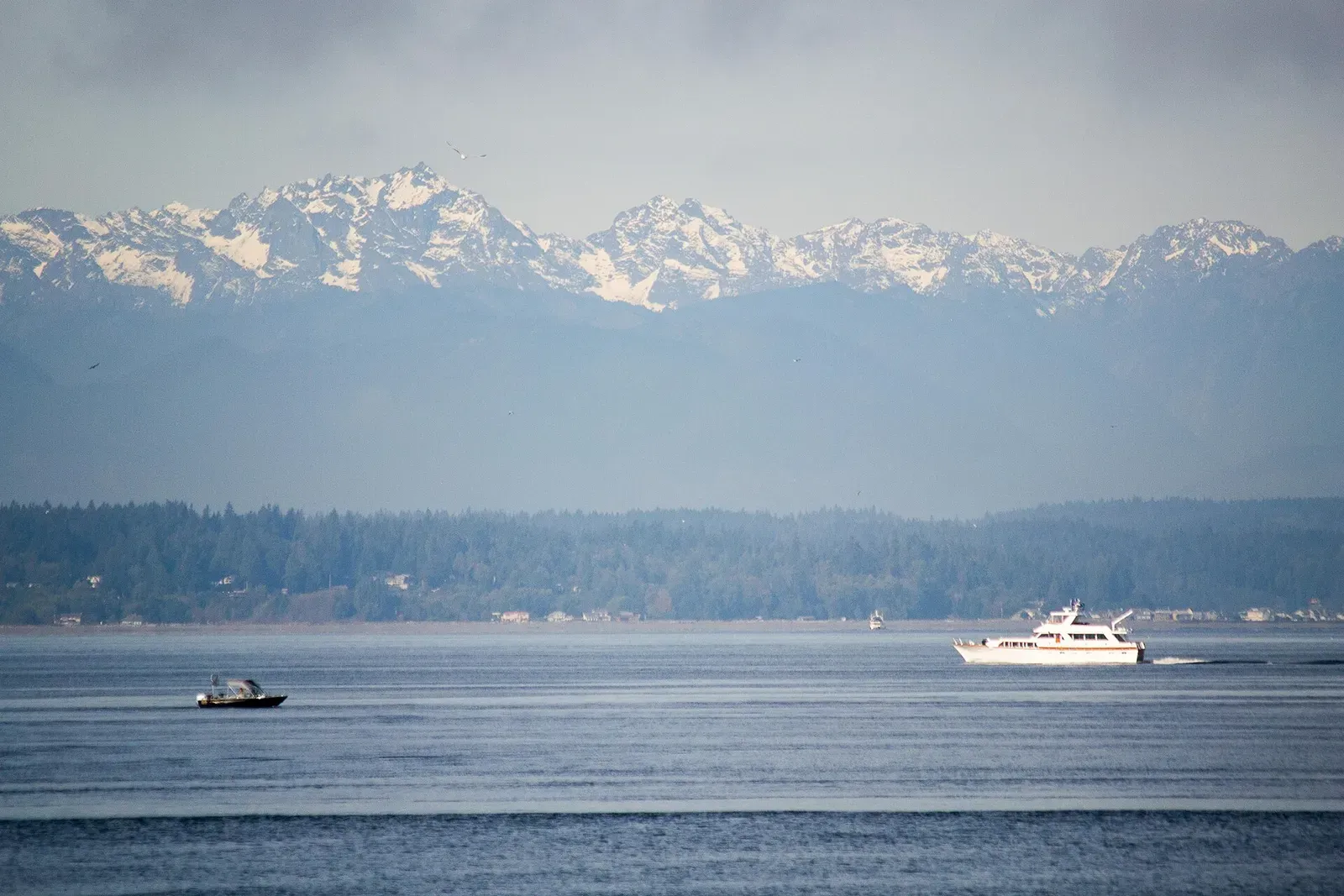
Cold Water · United States
Puget Sound
Giant Pacific octopus over 4 m across, and wolf eels paired in rock dens
Photo: Visitor7 · CC BY-SA 3.0
Puget Sound is a cold, dark, nutrient-choked inland sea, and it grows things bigger than anywhere else: the giant Pacific octopus reaches over 4 m across here, wolf eels pair for life in rock dens, and plumose anemones cover pilings in white forests. Almost everything is a shore dive, and almost everything is governed by tidal exchange — the sound moves an enormous volume of water twice a day, so most sites are strictly slack-water. Winter, counterintuitively, is when the water clears.
About diving in Puget Sound
A day here is planned off a current table, not a boat schedule. Divers pick the smaller of the day's two exchanges, work out slack for that particular site, which can run well off the prediction at the nearest station, and time the entry so the water is still while they are on the bottom. That can mean a start at first light or a long wait through the afternoon. Kit goes on at the car, the walk in is over cobble or a boat ramp, and a two-tank day often means two different beaches.
The sound is a drowned glacial trench and the profile shows it: steep silt-and-cobble slopes falling away from a narrow shelf, broken by rock piles, pilings and dropped structure. Colour comes from invertebrates rather than coral, with sponge on the deeper rock, sea stars and tube worms over the boulders, and bull kelp in the shallows through summer. Sites divide roughly into city-edge parks, the steeper and quieter walls down Hood Canal, and harder-flushed water toward the north end.
Winter is worth more than the visibility gain. Sunset comes early, so a night dive can start straight after work, resident animals are easier to find in the dark, and the shallow squid runs fall in the same cold months; sites that look plain at midday change entirely after sunset. The trade-off is that all of it happens in dark green water. A good primary light belongs in the kit next to the drysuit, and that holds at noon in August as much as on a December evening.
It suits divers who like doing their own planning and do not mind being cold for a hobby. There is no resort structure to lean on: you own or rent gear, fill locally, read the tables and go, which makes it cheap to dive often and a straightforward place to build cold-water hours. Several of the better-known sites are no-take preserves, one or two sit behind private land where a shop handles access, and taking a giant Pacific octopus is banned outright at a list of designated dive sites. Critter hunters and macro shooters get the most from it; anyone after warm water and big pelagics should look elsewhere.
When to dive Puget Sound
| Jan | Feb | Mar | Apr | May | Jun | Jul | Aug | Sep | Oct | Nov | Dec |
|---|---|---|---|---|---|---|---|---|---|---|---|
| Prime | Prime | Good | Good | Fair | Fair | Fair | Good | Good | Prime | Prime | Prime |
Oct–Mar gives the clearest water once the plankton dies back; summer blooms can cut visibility to a few metres.
Getting there
Fly into Seattle-Tacoma and rent a car; this is a drive-to-the-beach destination, with entries scattered from the city south toward Tacoma and west across to Hood Canal. Local shops handle fills, current advice and, at a few sites, the private-land access arrangements. Charters cover walls and wrecks beyond shore range. Park gates and hours vary, so check before an early start.
Wildlife calendar
Giant Pacific octopus, wolf eels and grunt sculpin are resident year-round, and nudibranchs and shrimp turn up on almost every piling. The cold months are the liveliest: market squid move into the shallows to spawn from autumn into winter and are best found at night, and male lingcod guard egg masses through late winter. Harbour seals turn up anywhere, and perch and rockfish school on structure.
Dive types & marine life
- Muck & macro
- Wall
- Wreck
- Night
- Kelp forest
- Octopus & cuttlefish
- Macro critters
- Nudibranchs
- Seals & sea lions
- Reef fish swarms
- Squid
Notable dive sites in Puget Sound
Cove 2
Seattle shore dive with sunken boats and reliable giant Pacific octopus.
Sund Rock
Hood Canal wall and rock pile, the best-known wolf eel site in the sound.
Edmonds Underwater Park
Purpose-built park with wrecks and structures in 5–15 m.
Keystone Jetty
Whidbey Island jetty in 12 m, dived only at slack on a small exchange.
Day Island Wall
Steep drop-off past 30 m with cloud sponges and swimming scallops.
Photos from Puget Sound
USEPA Environmental-Protection-Agency · Public domain
USEPA Environmental-Protection-Agency · Public domain
Joe Mabel · CC BY-SA 4.0
Dive videos
Edmonds Underwater Park - Our Underwater Backyard - Bruce Higgins Trails - Annie Crawley · Annie Crawley on YouTube
Curious Giant Pacific Octopus Interacts with Scuba Diver in Puget Sound · Kyle Newton on YouTube
Photo credits
- Snow-capped Olympic Mountains rising behind the calm waters of Puget Sound with two boats crossing by Visitor7, CC BY-SA 3.0, via Wikimedia Commons
- A giant plumose anemone with cream feeding tentacles extended on a Puget Sound rock wall by USEPA Environmental-Protection-Agency, Public domain, via Wikimedia Commons
- A wolf eel peers out from a rocky den on the floor of Puget Sound by USEPA Environmental-Protection-Agency, Public domain, via Wikimedia Commons
- Two scuba divers surface in open water off Brackett's Landing near Edmonds, Washington by Joe Mabel, CC BY-SA 4.0, via Wikimedia Commons
Similar destinations
Sweden's only cold-water coral reefs, inside its first marine national park
Cold Water
Lundy Island
United Kingdom
England's first marine reserve, and its grey seals follow divers around
The Rondo stands almost vertical, stern at 15 m and bow at 50

.jpg)
_in_Puget_Sound_(6842178290).jpg)

Jewel anemones and grey seals on a Berwickshire volcanic coast