Australia & New Zealand · New Zealand
Bay of Islands
The scuttled Rainbow Warrior under a coat of jewel anemones at 26 m
Photo: W. Bulach · CC BY-SA 4.0
Two ships define diving in Northland. The Rainbow Warrior, bombed by French agents in Auckland Harbour in 1985, was scuttled at Matauri Bay as a memorial and now lies at 26 m under a heavy coat of jewel anemones. The frigate HMNZS Canterbury was sunk in Deep Water Cove in 2007 with corridors and hatches cut open, sitting upright at 36 m. Between them, the bay's rock walls and caves carry the subtropical fish life that the East Auckland Current brings south.
About diving in Bay of Islands
Diving here is boat-based, and the day is shaped by which corner of Northland you are heading for. Charters leave in the morning from Paihia and Opua for the sites inside Cape Brett, usually two tanks with a long surface interval anchored somewhere out of the wind. The two wrecks lie far enough apart that operators generally run them as separate trips rather than pairing them, so a diver who wants both should plan two days and let the crew decide which one the forecast favours.
The bay is a drowned river valley, so the islands are the tops of old hills and the diving follows the same shapes underwater: rock faces dropping into sand, boulder gardens, and gutters funnelling between headlands. The outer cliffs at Cape Brett take the open ocean and hold the cave and swim-through work, and they are the first thing a swell takes away. Visibility runs anywhere from about 10 m to 30 m depending on whether the East Auckland Current is pushing warm water in that week.
The two wrecks also dive very differently. The Rainbow Warrior, off the Cavalli Islands near Matauri Bay, has been on the bottom long enough to read more as a reef than a ship, low and heavily overgrown, and it sits in open water that needs a settled day to reach. The Canterbury is still unmistakably a ship and big enough that most divers give it two dives: one around the outside for the shape of the hull, one working the opened-up interior with a torch.
This suits divers who are comfortable in cool water, roughly 14°C at the end of winter and low twenties late in summer, and who want structure rather than colour. A thick wetsuit or a drysuit is standard and a hood earns its place outside the summer months. December through April rate highest and May is close behind; June to August are still dived, but with greener water, more wind and a better chance of the boat standing down. Anyone hoping for tropical reef will be disappointed, and anyone who likes wrecks and rock will not.
When to dive Bay of Islands
| Jan | Feb | Mar | Apr | May | Jun | Jul | Aug | Sep | Oct | Nov | Dec |
|---|---|---|---|---|---|---|---|---|---|---|---|
| Prime | Prime | Prime | Prime | Good | Fair | Fair | Fair | Good | Good | Good | Prime |
Jan–May is warmest and clearest as the East Auckland Current pushes south; winter is cold, green and frequently blown out.
Getting there
Most divers drive up from Auckland or fly into Kerikeri, then base in Paihia, Opua or across the water in Russell for the Cape Brett and Deep Water Cove trips. The Rainbow Warrior is reached from Matauri Bay further north, a separate drive and a separate boat day. Everything runs off day boats; there is no shore diving worth the trip.
Wildlife calendar
Reef fish are thickest in the warm December-to-May stretch, when the East Auckland Current carries subtropical strays down the coast. Stingrays sit on the sand at the base of the rock, and octopus, nudibranchs and smaller macro life work the wreck structure year-round. Squid and the occasional New Zealand fur seal turn up as chance encounters rather than as something to plan around.
Dive types & marine life
- Wreck
- Reef
- Cave & cavern
- Wall
- Night
- Reef fish swarms
- Stingrays
- Nudibranchs
- Octopus & cuttlefish
- Macro critters
- Seals & sea lions
- Squid
Notable dive sites in Bay of Islands
Rainbow Warrior
Greenpeace vessel scuttled in 1987, at 26 m off Matauri Bay.
HMNZS Canterbury
Frigate sunk in 2007, upright at 36 m with cut-open corridors.
Cathedral Cave
Large sea cave on Cape Brett, entered from 12 m in calm weather.
Deep Water Cove
Sheltered reserve cove with rock walls and dense subtropical fish.
Photos from Bay of Islands
W. Bulach · CC BY-SA 4.0
W. Bulach · CC BY-SA 4.0
W. Bulach · CC BY-SA 4.0
W. Bulach · CC BY-SA 4.0
Dive videos
Diving Bay Of Islands, New Zealand. Rainbow Warrior & HMNZS Canterbury Wrecks · Mark Lev on YouTube
EX-HMNZS Canterbury Wreck Dive (Bay of Islands, NZ) · Khalid Riad on YouTube
Photo credits
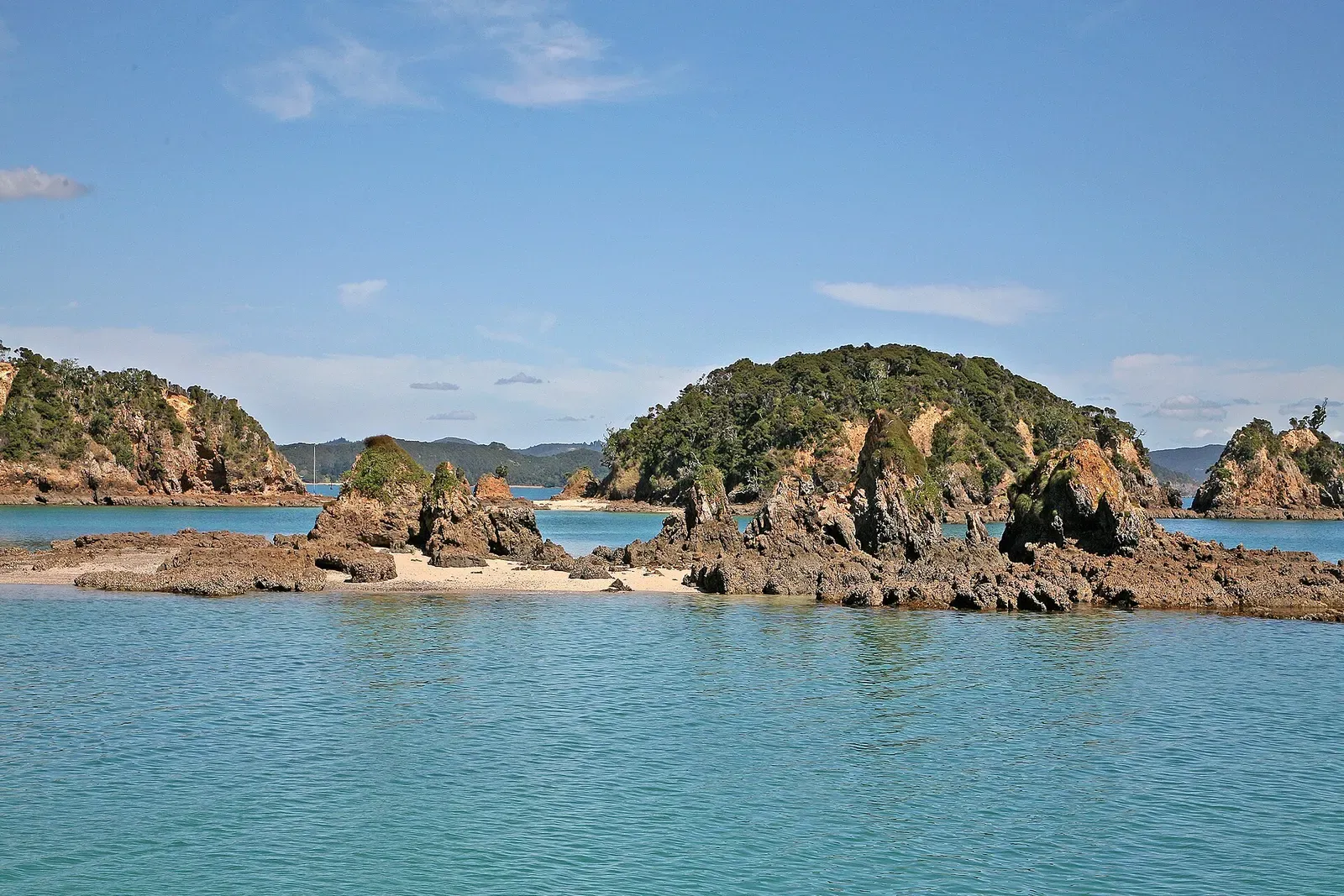
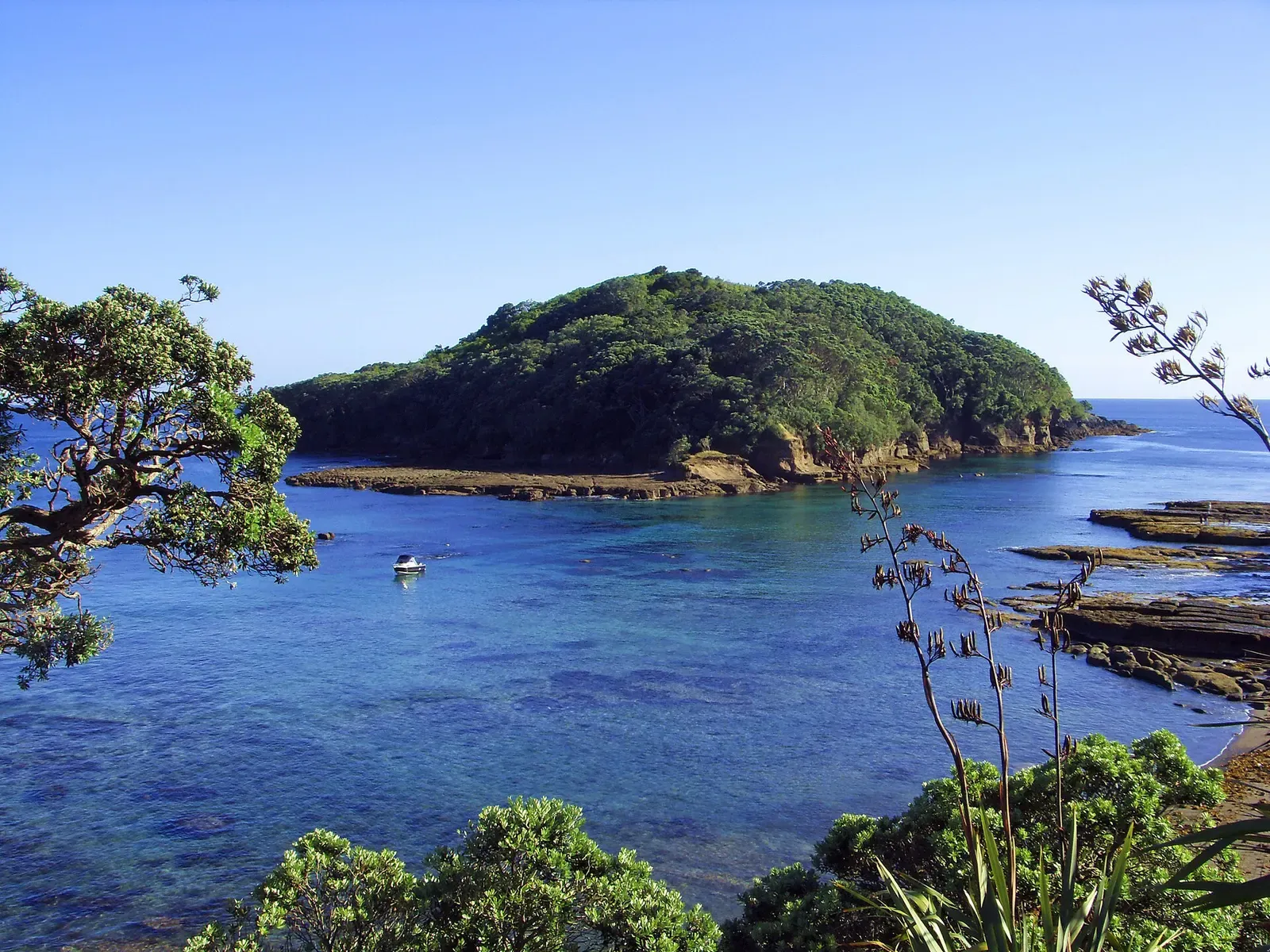
- Rocky islets and turquoise channels across the Bay of Islands, New Zealand by W. Bulach, CC BY-SA 4.0, via Wikimedia Commons
- A small basalt island rises from blue water in the Bay of Islands by W. Bulach, CC BY-SA 4.0, via Wikimedia Commons
- A small boat threads a channel between volcanic rock islets in the Bay of Islands by W. Bulach, CC BY-SA 4.0, via Wikimedia Commons
- A dolphin surfaces beside a boat in the Bay of Islands by W. Bulach, CC BY-SA 4.0, via Wikimedia Commons
- Two dolphins swim together at the surface in the Bay of Islands by W. Bulach, CC BY-SA 4.0, via Wikimedia Commons
Similar destinations
Thousands of spider crabs mass under a Melbourne pier each winter
White quartz sand lifts the light over temperate sponge gardens
Weedy seadragons drift through cold-water kelp forests off the Tasman Peninsula.


New Zealand's first marine reserve, and the snapper have stopped running